I'm definitely a fan of the KRK Rockit Studio Monitors!
I owned two sets of the KRK RP5 G1 series before. I sold my first set when i was about to go on a performance tour to another country and bought a same set after a couple of months there.
I remember using old passive studio monitors for a 20 song project. It was a full production of each song and deadline was short. Upon finishing the first two tracks, I submitted it to the client and on the spot they were rejected due to sound quality. I did another mix and again it did not pass. They waited for my third mix but I knew then that if that did not pass the qualities they're after, I will lose the contract. I called friends and did research and became interested with the KRKs, after all, Sony studios uses them. That same day my second mix was rejected, I got me a pair of KRK RP5s and worked on one song. It was heaven at first try as I could hear even the slightest nuisance and knew instantly what was wrong with my first mixes. The sound was clear, transparent without any additional colors which could interfere with my judgement. I've found "my studio monitor" at last!
The KRK RP5s worked well with most of my projects except for those which required mixing in the much lower frequencies like for RnB, Hip Hop and EDM genres, so I had to find another alternative to mix them; the KRK RP8s. Luckily, I had access to a friend's studio who had the KRK RP8 so I was not obliged to buy a set. Like the KRK RP5, the RP8 worked liked a charm.
To cut this short, on my opinion, I think KRK is at par with other studio monitors out there ten times its price. Now, I can't imagine working without them and they're a big factor why most of my mixes get approved even for the first they're heard.
==========
Now here is what the people from KRK have to say about the KRK Rokit 8 G3 Studio Monitors.
The KRK Rokit 8 G3 studio monitor gives you the amazing sound quality and accuracy that have made Rokits leaders in the industry for over a decade, plus a host of innovative features geared to meet the demands of today's most competitive producers and engineers. The Rokit 8 comes loaded with an innovative Class A/B amplifier pushing a composite woofer and a soft-dome tweeter, providing you with the high-headroom, low-distortion performance you need to really dive into your mix. Find out for yourself why KRK Rokit 8s are one of Sweetwater's most popular monitors.
KRK Rokit 8 G3 Active Nearfield Studio Monitor at a Glance:
Proprietary speaker combination delivers quality sound you can trust
High-performance custom amplifier provides essential tone control
Unique cabinet design ensures sonic accuracy and pristine stereo imaging
Proprietary speaker combination delivers quality sound you can trust
The most instantly recognizable thing about KRK monitors are those telltale yellow speakers. But there's far more to those speaker cones than their color. A combination of Kevlar and aramid fibers make the Rokit 8 G3 an incredible performer, delivering clear mids and tight bass. Add to that a soft-dome tweeter, and you'll get pristine highs extending all the way to 30kHz from your KRK Rokit 8 monitors.
High-performance custom amplifier provides essential tone control
One of the coolest upgrades KRK gave their Rokit 8 G3 studio monitors was a redesigned amplifier and active electronics system. For starters, this Class A/B amplifier delivers massive headroom and low distortion, keeping your audio clean and dropping your noise floor. In addition to that, Rokit 8s give you both high- and low-frequency controls, so you can tune your monitors to meet your environment.
Unique cabinet design ensures sonic accuracy and pristine stereo imaging
KRK's Rokit 8 G3, like the rest of the third-generation Rokit studio monitors, gains a lot from its unique speaker cabinet design. On the outside, the Rokit 8's radiused edges and proprietary waveguide provide a dramatically improved stereo image compared to standard square-edged cabinets. Internally, KRK designed the Rokit 8 to eliminate standing waves and other resonance issues, leaving you with pure, unadulterated sound.
KRK Rokit 8 G3 Active Nearfield Studio Monitor Features:
Versatile nearfield studio monitor that's great for any style of music
8" Kevlar/aramid composite woofer delivers clear mids and tight bass response
Soft-dome tweeter with proprietary waveguide provides smooth and lucid highs up to 30kHz
Active 2-way electronics provide high-headroom/low-noise amplification
High- and low-frequency controls let you contour your sound to your environment
Front-slotted bass port and resonant-free cabinet increase sonic clarity
Radiused edges and contoured front baffle provides clear sound and accurate stereo imaging
System optimized limiter prevents unexpected peaks from damaging speakers
64c3d8ba925bd17e2ab06a10b67081ef7c90019b9b383257e0
professional equipment reviews and testimonials / tips on set-up, calibration & performance / other cool stuff
Showing posts with label RECORDING GEAR. Show all posts
Friday, 26 May 2017
Saturday, 17 July 2010
Alesis M1 Active MkII Compact Active Nearfield Monitors
I actually learned the art of audio editing, mixing and recording at a friend's studio using a pair of Alesis passive nearfield monitor speakers which was later upgraded to Alesis M1 Active MkII Compact Active Nearfield Monitors. Back then when I started, I honestly had very little knowledge about how the speakers should work on a recording studio environment. I didn't realize then how crucial it was to have a "flat studio monitor system" so as you could mix music with the proper balance playable to all sorts of media playback device. I was lucky enough to start with a pair of decent Alesis monitors and from then my knowledge grew and clients came in. After having my own home studio, the studio where I first tinkered with sound design acquired the Alesis M1 Active MkII for their studio, and because I had a contract project for them, I was able to use it.
Although the Alesis M1 Active MkII is much cheaper than its passive predecessor, since it was a more recent model, the technology must of course be better. With an online selling price of $199 for a pair, it was a steal! The Alesis M1 Active MkII's design consists of cabinet material made of MDF with internal dampings on the insides. Main color is dark grey and laminated. Each unit of the Alesis M1 Active MkII measures 15x 8.5 x 10 inches and its edges are rounded for acoustic diffraction. The front edges of the speakers are mounted with glass fiber for additional damping.
A 6.5 inch driver is used as the woofer for the bass and mid frequencies and a one inch silk dome driver is for the tweeter. The cones for the woofer are made of carbon fiber which makes them stiff and light compared to other driver cones. The crossover point for the tweeter is set at 2kHz and the whole system's frequency range is from 50Hz to 20kHz which could be used to mix a lot of musical genres maybe except for those hip-hop tunes which require lots of bottom bass below 50Hz. The Alesis M1 Active MkII works well as nearfield studio monitor speakers for project or home studios and depending on the user, it's well capable of handling professional broadcast quality tasks.
Overall, upon testing the Alesis M1 Active MkII with audio CDs of different musical genres, it delivered clear quality sound with good tonal balance. Having a bi-amp design, the Alesis M1 Active MkII generates transparent audio which is good for mixing. At an affordable price, one could have a serious sounding 2-way studio monitor with full range performance.
***A Gizmo Guerilla Music Gear Review
Although the Alesis M1 Active MkII is much cheaper than its passive predecessor, since it was a more recent model, the technology must of course be better. With an online selling price of $199 for a pair, it was a steal! The Alesis M1 Active MkII's design consists of cabinet material made of MDF with internal dampings on the insides. Main color is dark grey and laminated. Each unit of the Alesis M1 Active MkII measures 15x 8.5 x 10 inches and its edges are rounded for acoustic diffraction. The front edges of the speakers are mounted with glass fiber for additional damping.
A 6.5 inch driver is used as the woofer for the bass and mid frequencies and a one inch silk dome driver is for the tweeter. The cones for the woofer are made of carbon fiber which makes them stiff and light compared to other driver cones. The crossover point for the tweeter is set at 2kHz and the whole system's frequency range is from 50Hz to 20kHz which could be used to mix a lot of musical genres maybe except for those hip-hop tunes which require lots of bottom bass below 50Hz. The Alesis M1 Active MkII works well as nearfield studio monitor speakers for project or home studios and depending on the user, it's well capable of handling professional broadcast quality tasks.
Overall, upon testing the Alesis M1 Active MkII with audio CDs of different musical genres, it delivered clear quality sound with good tonal balance. Having a bi-amp design, the Alesis M1 Active MkII generates transparent audio which is good for mixing. At an affordable price, one could have a serious sounding 2-way studio monitor with full range performance.
***A Gizmo Guerilla Music Gear Review
Saturday, 26 June 2010
ESI NEar05 EXPERIENCE studio monitor speakers
The nEar05 eXperience is actually the upgraded version of the nEar05 classic speakers which was specifically designed for serious home and project studios. Most online stores sell it at US$240 but I got mine at Tom Lee in Hong Kong during their sale for only HK$1,500 which is roughly equivalent to US$200. I was actually saving up for a pair of Genelecs which is quite expensive (well, for me that is), but I needed a pair of studio monitors quickly because of some projects that came up. Just in time, an accidental visit to Tom Lee led to me buying the nEar05 eXperience. Honestly, since I was hooked up on using KRKs and very impressed with the Genelecs, buying the nEar05 was not my priority, but I saw the big SALE sign which says HK$1,500 for a pair, so I thought why not give it a try. I was really surprised to hear such quality from such a price. So I asked for the box, manuals and specs sheet. For a home or small project studio, this would serve its purpose. I started to test it for another half an hour, which I think became a bit annoying to the store staff, but then, it's a music store right? So i did what I had to do. There is no doubt, I was convinced.
Features:
integral bi-amplified 70 Watt active near-field monitor
5 1/4" kevlar low frequency driver
1" silk-dome high frequency driver
cross-over control optimizes performance in relation to placement
magnetically shielded for desktop operation
input connections: 1 XLR balanced & 1 TRS balanced/unbalanced
input sensitivity: 200 mV
input impedance: 30k Ohm balanced, 15k Ohm unbalanced
Protection : RF interference, output current limiting, over temperature, turn-on/off
frequency response: 60Hz - 22kHz
crossover frequency: 3.2 kHz
low frequency amplifier: 40W
high frequency amplifier: 30W
blue power LED on the front
dimensions: 250mm (H) x 176mm (W) x 200mm (D)
weight: ca. 6.5kg / speakerThe nEar05 eXperience has a 5 inch Kevlar woofer which gives out quality ultra-flat low-mid frequencies. Kevlar..? hmm..same material they use for bullet-proof vests, but I don't think I'll be doing a shotgun test with my unit. ESI is actually the first studio monitor manufacturer to use kevlar and a lot of vendors have copied it from then, I think that includes KRK. There are no EQs on the speaker, just a level knob, which I think is fine since the frequencies are separated and optimized with the crossover (at 3.2khz). The nEar05 eXperience is also said to be magnetically shielded so it could function well beside any other equipment or gear without interference.
Upon getting home, I've done more tests with my new toy. Playing different kinds of music from hard rock, metal, acoustic, classical, etc.. I even became more convinced. The clarity is crystal and definition almost visual. Although it did not work well with Hip-Hop and R&B tunes (same with th KRK RP5s), there is an option to add a SW10K, a subwoofer speaker to complement the nEar05 eXperience making your system full-range capable of giving out all frequencies needed. Overall, for music production in a home or project studio, the ESI NEar05 EXPERIENCE studio monitor speakers will do a good job. For its price, function and performance, the nEar05 eXperience is one of the best buys I've ever done.
***A Gizmo Guerilla Music Gear Review
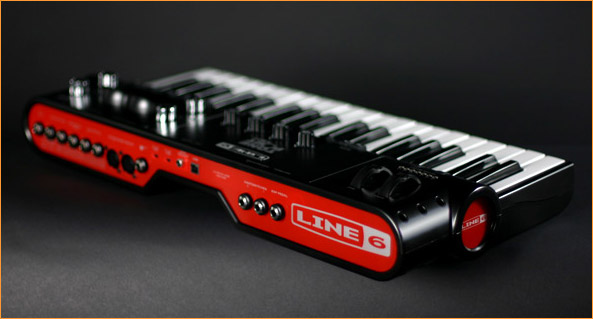
POD Studio KB 37 by LINE 6
Enter the Line 6 POD Studio™ KB37!
Ok, let's tale a look at the official features of the KB37.
It is basically a powerful USB audio interface with a built in 37 keys midi controller with the excellent sound of the POD Farm 2 and a highly comprehensive I/O. The POD farm 2 boasts of more than 80 guitar amp model simulators which can be tweaked and edited; perfect for recording guitar parts. But it is not limited to guitars alone... there also bass amps, preamps for vocals and stompboxes! It is actually a loadful of processors and gadjets at your finger tips, not just plug-ins.
The KB37's control surface has the "retro" look but gives the user full authority on its use. The keyboard features 37 full-sized keys which are velocity-sensitive, solid and has great response to touch. Other controls are modulation and pitchbend wheels, octave buttons, assignable knobs and buttons, play-stop-rewind-forward-record buttons and VU meters for visual monitoring of sound levels.
For the inputs, there is a 1/4 inch PL guitar input, 2 XLR balanced inputs for mics which goes thru the mic preamps, 2 1/4 inch PL line inputs and a 1/4 inch stereo monitor in. For the outs, there 2 1/4 inch PL analog outputs, a S/PDIF digital output, and headphone stereo out. There is also an option to plug in an expression pedal. The guitar input could be set to normal or pad and there is phantom power for use with condenser microphones. Such features offer the user a truly professional recording experience.
Other Key Features are:
> Lowest noise for recording guitar (12dB more dynamic range than similar interfaces)
> Exclusive latency-killing ToneDirect™ monitoring
> Up to 24-bit/96 kHz recording
POD Farm 2 (Mac® AU/RTAS®/VST® and Windows® RTAS®/VST®)
18 immortal guitar amps with 24 cabs
5 thumping bass amps with 5 cabs
29 stunning stompboxes and studio effects (instantly increases to 64 with included FX Junkie model pack!)
6 warm and colorful mic preamps
The KB37 is ideal for use with pouplar DAWs such as the Ableton® Live, Cakewalk®, Logic®, Garageband®, Pro Tools®, Reason®, Cubase®, and other major softwares for recording. Th unit is USB 1.1 and 2.0 compatible and includes the Ableton® Live Lite Line 6 Studio Edition 16-track ReWire enabled recording software, Reason® Adapted virtual studio and RiffWorks™ T4 recording software for quality and professional recordings. For its average price of US$350, the features and its functions are well worth it! This is simply your affordable, portable music production gear which could produce broadcast quality recordings depending on your know-how and how you use it.
Upon reading about the KB37, I thought this was the gear I was looking for so I took the risk and got one after a week of reading reviews about it. Actually, I was more than satisfied! I got my unit way back in 2007 and have been traveling with it since then. Once or twice a month I am involved in a studio project of some kind and the KB37 proved to be the ultimate tool for the recording musician on the road on a budget. But don't let it's small size fool you as the recording one could do with this is of broadcast quality comparable to the quality output of major and expensive recording studios. If one knows how to use this gizmo properly, the results are nothing less than astounding!
Now my on the recording recording gear has lessened; just a laptop, a pair of monitors, 2 sets of headphones and the Line 6 POD Studio™ KB37. What used to be contained in a big studio room in the 80s or 90s is now neatly packed in one hand-carry travel bag or big knapsack. I love technology.
Learn more about Music Production - Click Here!
***A Gizmo Guerilla Music Gear Review
Friday, 25 June 2010
RP-5 KRK Rokit Powered Studio Monitors
The KRK Rockit 5 or RP5 is actually my near-field home studio monitor. Why the RP5? Well I'll be honest, first of all it looks cute and cool! hahaha..check it out..
OK. Now that we've agreed on the looks (have we?), second main reason I chose this is because of the price. I went on a hunt for an pair of affordable pair of studio monitors with professional features and this seem to be a good choice with a price tag of US250 to US$300 a pair depending on the store or distributor. I was lucky enough to get a discounted price of US$250 at a local distributor whom I knew. Another feature I was looking for in studio monitors was that it should be powered and bi-amped (two separate amps for the tweeter and woofer). By being being bi-amped, a monitor would not choke or will not be confused when different frequency ranges are played. By logic, speaker movements vary with different sounds or frequencies and by having two separate amps, these frequencies are shared and not jumbled up as one. Comparing to other monitors which only have a simple amplifier, bi-amped monitors deliver more crystal-clear and well defined sound which allows a studio engineer to dissect parts more intricately. By the way, the model I have are the ones made in US, now, there are the RP-5 G2 which are China made. There's a little difference on the design of the cabinet but the claim is that the performance and quality is the same. Maybe I'll check it out some other time.
The distinctive yellow woofer cone design of the RP-5 is made of woven-glass Aramid composite... mmm.. I don't really have an idea what that is but according to the manufacturers it is more tough and well able to handle the frequencies it is assigned to. For the tweeter there is a 1 inch neodymium soft-dome with ferrofluid (whew! more scientific words irrelevant to sound). The tweeter and the woofer has independent systems which its own set of transducers, electronics and enclosures.
The dimension of the RP-5 measures 10 7/8 x 7 1/4 x 8 7/8 inches. the cabinet is made of medium-denzity fiberboard with multiple braces inside and a central septum. The main color is flat black and its corners and edges are rounded which they say reduces sound diffraction resulting in better audio imaging. There is also a bass port hole at the cabinet's front bottom side.
Now for frequency range, the KRK RP-5 is rated with a frequency response of 53 hertz to 20 khz at ±2 dB. Crossover is at 3khz made possible by a 24db/octave crossover filter. The tweeter amp is powered at 15W while the woofer is at 30W, with both amps low-noise and distortion. The DMOS audio amplifiers with the RP-5s are made by SGS-Thomson.
Let's look at the back. There an adjustable input sensitivity knob that goes from -30dB up to -6dB and also a high-frequency switch with four positions; -2, -1, 0 and +1dB. I like the inputs because it has a XLR, TRS Balanced and RCA unbalanced jacks which make it convenient to be set-up with whatever connection one wants or what is available. There is a 110/220 VAC IEC main connector for the power cable a an on-off power switch. Most monitors have the power switch at the back. Manufacturers should consider on putting them in front because at times it becomes quite tiring to stretch all the way to the back of the speakers to reach them. Anyway, I guess they wanted to engineers to do some stretching exercises from time to time...hehe
For the sound performance, RP-5s are great for mixing most types of music except those which need a lot of bass or low frequencies such as Hip-Hop and R&B. Since the low frequency is only up to 53 hertz, if you plan to mix lower than that, you should the KRK RP-10 subwoofer to complement the RP-5s to ensure you are hearing all the frequencies and just doing guesses or mixing by the numbers. I have worked in studios with monitors such as Genelec, Mackie and Yamaha and I must say that although the price of the RP-5 is just a small fraction of these monitors, the sound quality is really not that far. Maybe If I didn't know the difference with the speakers I would judge that the sound quality is the same. Before getting the KRK RP-5 I have worked with an old pair of passive Alesis monitors and sad to say, most clients requested for revision-remix. After getting the RP-5s, almost all projects were nailed at first submission. Well, it is unfair to judge the Alesis studio monitors because as I've said, they're old and passive, and maybe, my ears are just not used to them. In the end, how use what you have is always a big factor. For using studio monitor speakers, whatever it is you have, I suggest using them first as sound reference before putting them o actual mixing work. Listen to different genres of music, watch a movie and use it for audio, play it while you sleep. When you're ears have become accustomed to the sound your studio monitors produce, it would be easier to do mixes with quality results.
I use my RP5s with a Line 6 Pod Studio KB37. Check out what I have to say about the KB37, another great and affordable gear which is an ideal must have for home studio start-ups.
***A Gizmo Guerilla Music Gear Review
OK. Now that we've agreed on the looks (have we?), second main reason I chose this is because of the price. I went on a hunt for an pair of affordable pair of studio monitors with professional features and this seem to be a good choice with a price tag of US250 to US$300 a pair depending on the store or distributor. I was lucky enough to get a discounted price of US$250 at a local distributor whom I knew. Another feature I was looking for in studio monitors was that it should be powered and bi-amped (two separate amps for the tweeter and woofer). By being being bi-amped, a monitor would not choke or will not be confused when different frequency ranges are played. By logic, speaker movements vary with different sounds or frequencies and by having two separate amps, these frequencies are shared and not jumbled up as one. Comparing to other monitors which only have a simple amplifier, bi-amped monitors deliver more crystal-clear and well defined sound which allows a studio engineer to dissect parts more intricately. By the way, the model I have are the ones made in US, now, there are the RP-5 G2 which are China made. There's a little difference on the design of the cabinet but the claim is that the performance and quality is the same. Maybe I'll check it out some other time.
The distinctive yellow woofer cone design of the RP-5 is made of woven-glass Aramid composite... mmm.. I don't really have an idea what that is but according to the manufacturers it is more tough and well able to handle the frequencies it is assigned to. For the tweeter there is a 1 inch neodymium soft-dome with ferrofluid (whew! more scientific words irrelevant to sound). The tweeter and the woofer has independent systems which its own set of transducers, electronics and enclosures.
The dimension of the RP-5 measures 10 7/8 x 7 1/4 x 8 7/8 inches. the cabinet is made of medium-denzity fiberboard with multiple braces inside and a central septum. The main color is flat black and its corners and edges are rounded which they say reduces sound diffraction resulting in better audio imaging. There is also a bass port hole at the cabinet's front bottom side.
Now for frequency range, the KRK RP-5 is rated with a frequency response of 53 hertz to 20 khz at ±2 dB. Crossover is at 3khz made possible by a 24db/octave crossover filter. The tweeter amp is powered at 15W while the woofer is at 30W, with both amps low-noise and distortion. The DMOS audio amplifiers with the RP-5s are made by SGS-Thomson.
Let's look at the back. There an adjustable input sensitivity knob that goes from -30dB up to -6dB and also a high-frequency switch with four positions; -2, -1, 0 and +1dB. I like the inputs because it has a XLR, TRS Balanced and RCA unbalanced jacks which make it convenient to be set-up with whatever connection one wants or what is available. There is a 110/220 VAC IEC main connector for the power cable a an on-off power switch. Most monitors have the power switch at the back. Manufacturers should consider on putting them in front because at times it becomes quite tiring to stretch all the way to the back of the speakers to reach them. Anyway, I guess they wanted to engineers to do some stretching exercises from time to time...hehe
For the sound performance, RP-5s are great for mixing most types of music except those which need a lot of bass or low frequencies such as Hip-Hop and R&B. Since the low frequency is only up to 53 hertz, if you plan to mix lower than that, you should the KRK RP-10 subwoofer to complement the RP-5s to ensure you are hearing all the frequencies and just doing guesses or mixing by the numbers. I have worked in studios with monitors such as Genelec, Mackie and Yamaha and I must say that although the price of the RP-5 is just a small fraction of these monitors, the sound quality is really not that far. Maybe If I didn't know the difference with the speakers I would judge that the sound quality is the same. Before getting the KRK RP-5 I have worked with an old pair of passive Alesis monitors and sad to say, most clients requested for revision-remix. After getting the RP-5s, almost all projects were nailed at first submission. Well, it is unfair to judge the Alesis studio monitors because as I've said, they're old and passive, and maybe, my ears are just not used to them. In the end, how use what you have is always a big factor. For using studio monitor speakers, whatever it is you have, I suggest using them first as sound reference before putting them o actual mixing work. Listen to different genres of music, watch a movie and use it for audio, play it while you sleep. When you're ears have become accustomed to the sound your studio monitors produce, it would be easier to do mixes with quality results.
I use my RP5s with a Line 6 Pod Studio KB37. Check out what I have to say about the KB37, another great and affordable gear which is an ideal must have for home studio start-ups.
***A Gizmo Guerilla Music Gear Review
Subscribe to:
Posts (Atom)