Showing posts with label DRUM GEAR. Show all posts

Friday, 26 May 2017

How To Manage Drum Overtones

At times, drum overtones can become a nightmare not only for the drummer but the whole band, sound engineer to the extent of the listening crowd as well. Although, overtones and sustain seem to go hand in hand, it can be annoying when there is too much but also makes your drum sound dull when totally killed. So, where to we draw the line? Here are Gig Warrior's tips on how to manage drum overtones to make life a bit easier.

Drums and drumming most times is subject to preference so it is hard to pinpoint what is really right or wrong because thereˊs almost none. Instead, drums can be judged by whatever sounds good or bad, but then again, subject to preference.

Usually, it is wise to dampen or lessen overtones as much as possible because the notes from these overtones actually messes with the whole mix to the point that a song being played could sound out of tune. There are three basic ways to dampen drum overtones: first is by using the drum key, second is by placing a ring damper and third is by using masking tape and tissue paper. Although one can also tackle experimenting with room acoustics which does work, for now we discuss what would be the basic and immediate ways a drummer can use.


With the drum key, you need to adjust the bottom sides first or opposite the skins that you hit, called resonant skins or snare side skin for the snare. It should be adjusted just tight enough so that it can still have flexibility to move or resonate. After that, you go on to the batter side and adjust it according to your preferred note. Now, when you hear and think that itˊs got an intrusive overtone, try tightening or loosening the resonant side until you hear the overtone become weaker without losing your desired note. After that, adjust only one lug on the batter side while hitting the drum. Slowly loosen that lug until you the overtone is gone or at least minimal. It is important that you adjust only one lug.


For the second option, you can buy a drum ring damper which is actually the same material as the drum skins cut like a donut. Dampers or drum rings are available in different sizes and usually it can solve drum overtone problems easily just by placing them on top of a drum. Although for some instances using dampers can become too much that it ruins the drumˊs natural sound, most times it works fine which is why as a drummer, I always bring dampers for the snare, tom 1, tom 2 and floor tom and use them depending on how the room acoustics affect the drum sound. This is a rule of thumb for drums or any music source for that matter: Same equipment and same players, set up at different rooms or venues equates to different sound each time.

Now letˊs go to what seems to be a more barbaric solution by using adhesive tapes and tissue paper. As crude as this may sound, this works on the same principle as the ring dampers that you can buy but actually more efficient. Yes, efficient because you actually have control of just how much damping you need to apply to achieve minimal overtone nuisance but enough sustain. Just make sure that your are using soft tissue and adhesive or masking tape that really sticks.

Although most times, our concern is to kill overtones, there are actually instances that we need them and some artists that want them. If one knows how to properly manage drum overtones, it can actually make the overall sound or mix better.

I, in particular, love drum overtones as long as they are in tune. Of course this would depend on the Key scale of a particular song you are performing so using overtones is best used inside the controlled environment of a recording studio but not recorded when playing multiple songs of different keys in a live performance. I actually started using overtones for recorded work by accident. I was on a studio session run and my drum track had this terrible overtone on the toms which was colliding with the other instruments. I was struggling to lessen the overtones without sacrificing natural sustain since the song seems to ask for it. Our sound engineer recommended that I tune the whole kit to a scale within the key of the song and I did so with reference to a keyboard. It was a tedious task since unlike a guitar where you only turn one knob to tune, a snare or tom would has 12 to 16 lugs. After more than an hour of tinkering and tuning the kit, we were ready so we did another take, but this time, we did not dampen the drums to kill the overtones and instead highlighted it. It was amazing! The drum-kit produced loud powerful notes with overtones which blended well with the mix. I was blown away and my perception of drum overtones totally changed after that.

Drum overtones can be a nightmare which you may want to kill but it can also be your friend; the key is knowing the difference and learning how to properly manage them.

Wednesday, 7 July 2010

Paiste PST 5 Rock Set Cymbals


I think this time I'll review some cymbals, particularly a set which I just recently bought at a local music store around the corner. The Paiste PST 5 Rock Set has an online price tag of US$345 but we got ours during a high discount sale season for the price of HK$2,000 which is equivalent to US$257. It wasn't really my plan to buy a set, and was supposed to buy only a crash to replace the old and cracked Zildjian I've been pounding fro the past several months. Since the price of a single crash was not so far from the price of the Paiste PST 5 Rock Set Cymbals, I thought it would be wiser to buy the set.

The Paiste PST 5 Rock Set Cymbals included a pair of 14" inch Rock hi-hats, a 16" Rock crash and a 20" Rock ride; just the basic set-up with standard sizes. The cymbal set was very affordable and wasn't really on the high-end product list of Paiste so my expectations weren't much but overall, the cymbals' performance far exceeded my conservative expectations.

Straight from the music store I went to the bar to set up my new toys. I played around it for about half an hour and it sounded very decent and professional but it was still to be put to test on its baptism of fire during an actual gig.

11 pm: gig - time to put the Paiste PST 5 Rock Set Cymbals to real life test. For our first set as a full band, we usually play lighter music on weekdays, perfect time to see if the cymbals could handle finesse and subtle performances. I liked the hi-hats very much, like its model name, it produced a "pst" sound which is controllable. The sound was bright, clear and cutting without going of the mix. The rock crash was fine but too thick sounding for light music and the ride also sounded to thick, for my choice that is.

After our first set, our second set was comprised of classic rock hits which needed a lot of power and attack. Only then did I hear the Paiste PST 5 Rock Set Cymbals full potential. The crashes handled heavier songs with justice, the hi-hats could loud or subtle depending on how you control it. The ride had a good ping, bell and enormous wash sound which was needed for thrashy rock tunes. Overall, it was a true rock cymbal set!

The Paiste PST 5 Rock Set are affordable cymbals from a trusted brand name made from high-grade bronze alloy of professional class. Affordable and cheap yes, but "cheap-sounding"... certainly not. I think it's worth way more than its actual price. Although I'd still prefer a slightly thinner ride sound, I'd use this set for live or studio applications anytime.

***A Gizmo Guerilla Music Gear Review

Thursday, 1 July 2010

Zildjian Drumsticks

I was just thinking of what other things I could review or write about concerning drum gear, and I just thought why not drumsticks? I guess it's a lame excuse for me for not being able to finish a review on the Pearl Eliminator Demon Drive Double Bass Drum Pedal, but then sticks are actually of great importance as well. As most drummers would say, your sticks are the extension of your arms.

I use different kinds of sticks from time to time out of curiosity and because a lot of friends gives me sticks as gifts so I'd use it no matter what brand or model it was. But for my personal preference, for years and years, I've been so used to using Zildjian Drumsticks. Of course there are like hundreds of models of Zildjian sticks but I'll just stick to those which I know and have used a lot. These Zildjian Drumstick models are namely the standard 5A, 5B, 2B and 7A. Depending on the situation and my physical condition, I have these sticks at hand and choose which one is appropriate for the gig.

First of all, my drum sticks for all occasions, the one pair I'd never be without - The Zildjian 5B. Slightly larger than the 5A and has got a larger tip, for me, its weight, length, thickness and recoil is perfect. It could handle any type of musical genre, although I guess it is actually dependent on the drummer. The Zildjian 5B drumsticks could be used for soft and subtle approach or for an all out frenzy-manic drum attack. As for the 5A sticks, I hate to say this but I'll be honest, I buy it when they run out of the 5Bs. Since the difference between the two sticks are very minimal, it will do. But a lot of players find 5A the drumstick of their choice.

Now the Zildjian 2B; which are bigger, heavier and gives out a fuller more powerful sound with less effort. Yes, having it in your arms might be heavier but then you exert less effort when it's time to hit because its natural weight drives it as well. I usually use these for short concert gigs on large venues where there are no bar owners or managers that'll complain. But I don't use it on regular gigs where we do several sets, as it may become very tiresome.

The Zildjian 7A Drumsticks although slim packs a lot of power too because of the heavy part near the tip. But since the area of the wood that hits the skin is smaller, relatively, the sound it produce has lesser body compared to the 5B or 2B. The punch is there but the body is not, but then, the sound or tonal quality is of personal preference so what may be bad to me is good for others. I have these sticks just in case we play places where the over-all level needs to be so low (like dinner or wedding gigs) that the sound of the spoon and fork hitting the plates are louder than your snare hits! Believe me, there are gigs like this. The Zildjian 7A could deliver precise and punchy notes with less the volume, although this could also be achieved using any type of drumsticks by physical dynamics, having the 7A will make things easier. There are also times when I am just to tired or maybe sick, but the show goes on, these 7A drumsticks by Zildjian can save the day.

Bear in mind, these are "my own" personal preferences on drumsticks, in the end, it is a personal choice. What you want to use, what you're used to and what sticks you think you could perform at your best is what matters most. The only best way I know to get to know which drumsticks are for you is to experiment, keep on using different types and brands of drumsticks until you decide which one is for you. Happy drumming!

***A Gizmo Guerilla Music Gear Review

Tuesday, 29 June 2010

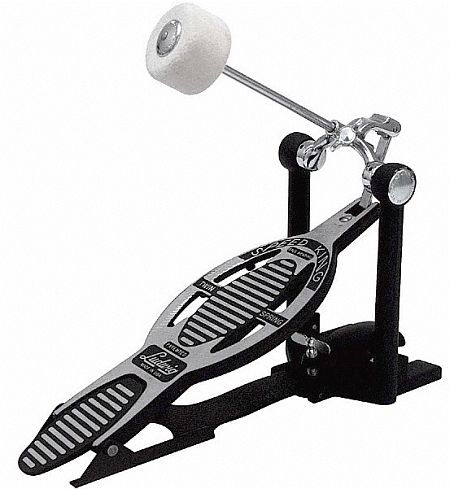
Ludwig's Speed King - a legendary drum pedal

Starting out playing with the drum-kit when I was just around 10, I had no idea about the brands, names and never gave value or care to the equipment I used. Only after several years did I realize that the first kit I ever played on was a classic Ludwig (have no recall on the model), Zildjian Avedis cymbals (of which I still have) and Ludwig's Speed King drum pedal. Now that the kit is no more, the pedal has been lost, I'd give up my new gear to get those old ones back.

I was using the Ludwig Speed King drum pedal, referred to many as the best drum pedal in world, period! Well, I actually have no recall of how it performed way back then, but I bought one of my own after about ten years. I've gotten a used Speed King but I'd prefer it from the new re-issues. I got the vintage ones but in top condition. Unfortunately, I lost it too during a concert tour somewhere when our gig was canceled due to earthquakes and volcano eruptions! I'm not making this up, it did happen. Anyway, enough of me and more of the Ludwig Speed King.


The new re-issues are priced at US100-120 which is not much for such a good quality and named single pedal. The main features of the Ludwig Speed King that differentiate it from other pedals is its direct drive system wherein a C shaped metal flat rod is used instead of a belt or chain; this eliminates lag when playing thus gaining more "Speed". The springs, unlike in other pedals, are hidden inside the main posts which prevents the springs from tangling with the drummers pants or shoe laces or legs and also giving a more faster response time. The Ludwig Speed King's design is effective and simple but revolutionary. Unfortunately, I can not use the Ludwig Speed King drum pedal for our gigs because it doesn't have a double-pedal version. To achieve double bass using the Speed King, I'd have to have 2 bass drums and 2 sets of single pedals; quite to bulky for most stages and a logistical nightmare to bring along.

Among the greats who used the Ludwig Speed King drum pedal are John Bonham and Ian Paice. When players like that used it, it's a bit hard to argue about its performance.

***A Gizmo Guerilla Music Gear Review

Axis Longboard Double Pedal

Although not as popular as other brands such as DW, Pearl, Tama and others, Axis Percussion has been around for many years and known for making drum gears and accessories at a rather unique and revolutionary way but effective. One of their products which has been making raves especially in the world of power and speed drumming is their Axis Longboard Double Pedal.

I am a drummer and I own 3 sets of double pedals, an old Tama double pedal, a cheap nameless generic double pedal from China which works quite well and very light (ideal for tours), and recently a Pearl Eliminator double pedal which I got second hand. I also have other single pedals which I haven't really used for years now. I saw a drummer friend of mine based in Canada who just got the Axis Longboard Double Pedals and I was curious. According to him, it took a little adjusting and getting used to in playing but after a short time, his speed and power increased significantly. Being a curious drummer that I am, I had to check it out. By luck, I had a friend who just got his as a present. They played light jazz music and he was so used to his old Ludwig Speed King (my favorite single pedal), that he just opened the box and did not really use the Axis Longboard Double Pedal. He was kind enough to lend it to me for a couple of days. I felt a bit guilty because it was his gift and I'll be the first one to use it.... hehe..but what the heck.


The Axis Longboard Double Pedals had a very different and unique design compared to other double pedals. To me it looked like a spare part of an old spaceship that crashed somewhere. It looks very robust and mechanical. First time I've encountered such a pedal design in my 20 years of drumming. According to some and the manufacturers, they favored functionality over design "cuteness". Now I realize what they meant about Longboard... the foot area on the pedal was really long. Reminded me when I used Trak single pedals way back, which I enjoyed cause of the long board as well, but the Axis' was longer! It had about 2 inches more than other conventional pedals. Not only was this perfect for large footed drummers, one could also do a lot of footwork on it. being accustomed to playing nightly, many sets and long hours, I had to develop many types of footwork while playing to cope up. 

Other than the craved logo-name Axis in color red, the Axis pedal looks very plain. Over-all it may not look very attractive to a lot of people or players... but hey... drum pedals weren't really meant to look good right? they are something we step on hard, thousands of times nightly and what matters is how it relates to our physical playing. 

Yes, the pedals do look plain and unattractive to many, but its adjustable features are nothing but superb! It has almost all the adjusting features of other doubles bass pedals on the market plus more. Almost all pedals has adjustments for distance of each pedal set, tension of springs and beater height. The Axis Longboard Double Pedal is direct drive so it has no chain or belt adjustments. The beaters' distance from one another  could also be adjusted horizontally. Aside from that, the beater head angle could also be adjusted and how much of it is sticking out near the skin; a big advantage compared to other double pedals. By these adjustments, not only can it improve your playing, but it could also make changes in the tonal quality of the bass drums. It took me awhile tinkering with all these adjustments. Again, I was like a child with a new toy (although just borrowed).

Similar to Ludwig's Speed King, the Axis Longboard Double Pedals are direct drive which eliminated the lag caused by belts and chains. That crucial fraction of a second counts a lot when you are playing at high speeds or you want precision in laying down your notes. The response is fast and accurate, as if it were part of your limb. Given the fast response plus the long board, using the heel-toe sliding technique on the board was easy. In some pedals, it is quite hard because of very little room to move about on the pedal boards. Aside from its mechanical function, the Axis Longboard Double Pedals are also very light.  A lot of touring drummers would find this very favorable. Before a gig, it might just fine to carry and set-up a heavy double bass pedal, but after   the gig, a few bottles of beer and all those release of adrenalin, it would be hard even to just lift your key chain. 

Ok, back to playing. Speed and power is certainly not an issue as I could feel how the beater kicks in and how it became easier to play faster double bass licks. However, when I tried playing  soft bossa or salsa at low levels, the beater still kicked in hard..... mmmm.... was it just me? I took it off and placed my Eliminator back, and I was able to do it how it should be. Then the Axis Longboard Double Pedal again. But then, I;ve only had it for a few hours and had been used to playing the Eliminator a long time, so I can't really rely on my judgement, yet. For me, as of the short time I used the Axis Longboard Double Pedal, it proved perfect for speed-hard-power metal drumming but not yet for music which required a lot of dynamics. Yes, double and triple kicks could be achieved easily due to large area for footwork, but I just couldn't put in dynamics such as  making the first not of a double kick softer and the second harder and louder. With the Axis Longboard Double Pedal, it seems that my foot was set on automatic limiter-compressor leveling out the notes at maximum dB.

My friend doesn't know how much his pedals cost because it was a gift, but depending on models, the Axis Longboard Double Pedals is around US$400 to 750. Again, adjustment features are top-notch, longboard means more space for footwork, speed and power is truly incomparable.... dynamics and versatility for use in different styles is in question, in my case that is. But for all you speed and power maniac drummers out there, this is for you!


***A Gizmo Guerilla Music Gear Review

Sunday, 27 June 2010

AKG D112 Kick Drum Mic

Referred by many as the best kick-drum microphone in the world, the AKG D112 Kick Drum Mic's reputation in the music industry is unmatched. It is a large diaphragm dynamic microphone with a very high SPL well able to handle up to 160 dB without having distortion, this kick drum ic can handle the heaviest footed drummer out there. It;s diaphragm is carefully engineered so that the low resonance frequencies handle frequencies below 100Hz very well having a powerful and solid response. There is also a natural rise at around 4kHz (meaning no EQing or very little) which gives out clear punches and presence of sound. So what do you have? A kick drum which delivers powerful, punchy notes which cuts but still maintaining the body needed. When purchased, the AKG D112 Kick Drum Mic comes with the SA 60 stand adapter.

Personally, I've used this mic in studios and many live applications. Now, it is still the one we use for daily abuse in a bar, and night by night it delivers superb sound and performance without a twitch. We've never encountered distortion, booming or feedback ever, and yes, we do play very loud. I use the AKG D112 Kick Drum Mic with a compressor-gate. I set the EQ to a level where the bass will boom and cuts it with the gate almost instantly and add highs at around 12kHz and boost it at 5kHz. The gate cuts of the boom and the highs gives presence so I have a huge drum sound that cuts through and well defined even for fast double bass patterns. But you must be aware that for different venues and conditions, EQing would vary a lot, so what would work for me might not for you. For example, we play in bar where there are mostly mirrors and steel within the interior, this means it will complement a lot of high frequencies. Vice-versa a well padded venue would produce lows. A fully packed venue will sound very different from a venue with very few people. It's knowing the acoustics of your venue, the sound you want and your ears that matter most when it comes to setting the proper equalization.


Technical Features of the AKG D112:

A classic Large-diaphragm dynamic microphone for bass instruments with extremely high SPL capability
Extremely high SPL capability - Handles up to 160 dB SPL with no audible distortion
Classic microphone for stage and studio applications
Frequency Range: 20 Hz to 17 kHz
Polar Pattern: Cardioid
Sensitivity: 1.8 mV/Pa (-55 dBV)
Impedanc e: 210 ohms
Size: 150x70x115 mm (5.9x2.8x4.5 in.)
The AKG D 112 has a built in windscreen and SA 60 stand adapter included

For the online price average of US$160, it's well worth it!

***A Gizmo Guerilla Music Gear Review